Showing posts with label webinar. Show all posts

New Year, New Treats!

Tuesday, January 3, 2023

2023 is off to a good start, with a handful of fantastic webinars coming up in the next few months! Here are some of the things to look forward too, and will hopefully come in handy when planning for the upcoming season:

'Getting Into the Weeds' Seminar Series 

Introducing the next season of the Getting into the Weeds seminar series! 2022 saw a significant cost increase for production inputs, and combined with the global supply chain issues we have been experiencing over the past few years, agricultural production is becoming more challenging. This year's seminar series is comprised of 4 information sessions focusing on maximizing efficiencies on farm. These sessions will focus in on pesticide application, nutrient management, on-farm input efficiencies (labour etc. ), as well as the trials and tribulations of on-farm plots.


For those who are interested in attending these free webinars, please find additional speaker details and instructions for registration on Perennia’s learning page.


If you have any questions about these sessions specifically, please contact Hugh Lyu (hlyu@perennia.ca; 902-890-0472) or Talia Plaskett (tplaskett@perennia.ca; 902-305-3419).


Herbicide Management Tips for Integrating Cover Crops into the Rotation

Join Perennia Field Crops Specialist Caitlin Congdon and John Wallace, PhD, Assistant Professor of weed science at Penn State University, as they discuss how to integrate cover crops into the rotation and the potential impacts for your herbicide management program. 


Register now to secure your virtual spot and help set yourself up for a productive growing season! 


This event is being held as part of the On-Farm Climate Action Fund (OFCAF) program. The goals of the program are to encourage on-farm sequestration of carbon and reduction in greenhouse gases through the implementation of improved nitrogen management, enhanced cover crop adoption, and the normalization of rotational grazing. For more info on the OFCAF program, please visit ofcaf.perennia.ca 


Managing Nitrogen in Protected, Soil-based Systems

Managing crop fertility in protected spaces can be difficult to navigate throughout the growing season when deciding what to apply, how much of it and when. Join Judson Reid from Cornell University and Perennia Specialist Talia Plaskett on February 9, 2023, at noon to learn about nutrient management in protected, soil-based crops.


Register now to secure your virtual spot and help set yourself up for a productive growing season! 


This event is being held as part of the On-Farm Climate Action Fund (OFCAF) program. The goals of the program are to encourage on-farm sequestration of carbon and reduction in greenhouse gases through the implementation of improved nitrogen management, enhanced cover crop adoption, and the normalization of rotational grazing. For more info on the OFCAF program, please visit ofcaf.perennia.ca 


Cover Cropping in Tunnel Spaces


Cover cropping has proven to be quite beneficial in field production and is gaining a lot of momentum across Nova Scotia. This raises the question – is this a practice that can be adopted in protected production? Join Judson Reid from Cornell University and Perennia Specialist Talia Plaskett on March 23, 2023, at noon to hear about the work done around cover cropping in tunnels and see how this practice could apply to your farm.


Register now to reserve your virtual spot and start thinking about what your off-seasons could look like! 


This event is being held as part of the On-Farm Climate Action Fund (OFCAF) program. The goals of the program are to encourage on-farm sequestration of carbon and reduction in greenhouse gases through the implementation of improved nitrogen management, enhanced cover crop adoption, and the normalization of rotational grazing. For more info on the OFCAF program, please visit ofcaf.perennia.ca

  • For a full list of the learning opportunities hosted by Perennia, check out the events page here

  • For more information on OFCAF, funding and application windows, and the training available, check out their website here.

Here is to a successful 2023!

Posted by: Talia Plaskett


Webinar Alert - Energy Alternatives in Protected Production

Wednesday, May 4, 2022

 Greenhouse Canada is hosting two free webinars on energy that are coming up soon!

Thurs May 5 at 3pm (Atlantic):  Biomass – Fire up the greenhouse

Biomass may be considered a renewable energy source, but where does it fit into Canada’s clean energy future for greenhouse agriculture? Learn about its use, the importance of fuel sources, as well as new developments that could give it a place on the journey towards net-zero emissions. Register here: https://us02web.zoom.us/webinar/register/WN_s8xsNXl7Rd-jNwiaB_tG0A


Wed. May 11 at 3pm (Atlantic): Reducing Carbon Emissions – Now and in the Future

What can greenhouse growers and vertical farming operations do to reduce their carbon emissions both now and over the next decade? This webinar will be centred around three main pillars: natural gas, demand-side management and low carbon solutions. Register here: https://us02web.zoom.us/webinar/register/WN_fVz9J78TS-WX5SlGY1E_aw


Each session will have a live Q&A, where you will have an opportunity to chat to the experts directly! Can't attend the event? Registering for the webinar will give you direct access to the recording afterwards, so it is worth putting your name in!

More info and registration can be found in the links above! See you there

Posted by: Talia Plaskett


Webinar Alert - Plant Health Virtual Conference

Monday, March 14, 2022

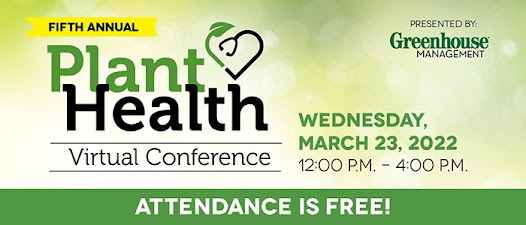
 Get those calendars ready folks, we have another greenhouse webinar coming up! This (FREE) virtual event takes place Wednesday March 23 from 12-4pm EST and focuses on various ways to improve on plant health in controlled environments. 


So, what are we going to be hearing about?

Watching Water Quality - 12:20 - 1:05 pm

Water quality is extremely important to consider for protected production, especially in a hydroponic setup. Water quality can impact long-term root-zone pH and EC, as well as root disease susceptibility, pesticide applications, equipment longevity and appropriate fertilizers. Neil Mattson, Associate Professor at Cornell University, will discuss why and how often you should be submitting your water for a quality test. From there, he will review some of the key aspects to focus on when interpreting the results from the lab, as well as highlight some of the things on that report that are slightly less important to help keep us on track. By understanding your water, and the impact it has on your crop, you can help mitigate any water-based headaches around the facility and help improve the overall growing conditions (and productivity) of the crop

The Physics of Spraying in Closed Environments- 1:15 - 2:00 pm

Jason Deveau, the Application Technology Specialist at OMAFRA will explore the physics of spray application methods that are specific to closed environments. By understanding how spray behaves, and through using simple diagnostic methods to characterize your current spray tendency, operators can improve the efficacy and productivity of the products applied in the protected space.

Quality Assessment of Biological Control Agents (BCA): Why It Is Important to Know if your BCA are Alive or Dead - 2:10 -2:55 pm 

Dr. Raymond Cloyd, Professor/Extension Specialist out of Kansas State University will provide an overview of biological control, and then focus in on the importance of developing quality assessments to ensure that your BCA are functional. Functionality is key for successful insect and mite populations, so it is important to implement these assessments into your usual routine!

Growing Media Selection for Optimized Plant Health - 3:05-3:50 pm

Dr. Brian Jackson, Director of Horticultural Substrates Laboratory at North Carolina State University, is going to talk about the importance of selection and management of growing media. When done properly, it is easier to promote root growth and development, which is crucial for overall plant health and success. Additionally, precise water management of substrates/containers at different times over the cropping cycle of plant production can aid in growth regulation as well as the post production shelf life of plants. Dr. Jackson will also comment on new substrates that are entering the marketplace, and talk about how they compare to traditional mixes when it comes to water management. 

______________________________________________________________

This fantastic line up will help get you start your growing season on the right foot, so definitely consider tuning in if you are looking to improve the quality of your greenhouse plants! 

If you are interested in registering, or learning more about the event, click here

Below the Surface - What Else is your Soil Test Telling you?

Friday, March 11, 2022

 If you haven't watched Perennia's latest webinar on interpretation of soil reports...run, don't walk, to our Youtube channel! (Just kidding, you can also click here). 

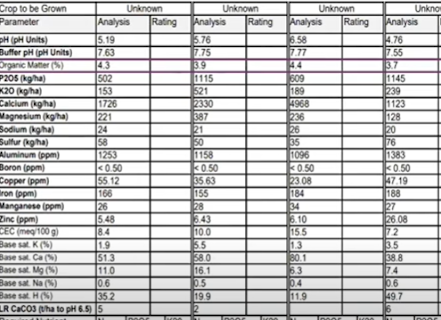
Join our soil specialist Caitlin McCavour as she goes through the results generated from a soil sample submitted to the NSDA testing lab, and further explains what those values mean, and the impact it has on your crop. For the record, while this report might look similar to what is generated for a substrate-based nutrient analysis, they are not the same test! Make sure to double check the analysis you are requesting, and that it is suitable for the growing media you are using in your operation. 

Below you can find some of the questions she answers throughout the webinar: 

Go through the Elements of the Soil Test Report

What is the difference between the posted pH and the buffer pH row?
Where can I find the recommended amount of lime required for pH adjustment?
How do you select the best amendment to increase soil pH ?
Why is organic matter important?
Essential elements for plant production 
What are the ranges used to determine if my levels are low or high?

Cation Exchange Capacity

What influences the ability of a soil to have an increased or decreased ability to hold onto cations?
Who are the acidic and basic players? Are they considered equal in binding capacity?
How is this going to change your management practices?
The role of CEC in timings and volume of fertilizer applications

Base Saturation

What is base saturation?
How is it different from cation exchange capacity?


Rather than trying to summarize all of the awesome information here, I highly recommend you sit through the 52 minute webinar. If you have any questions about your soil test, and the management recommendations that go along with it, don't hesitate to reach out !


Product Registration Changes Impacting Horticulture

Monday, February 14, 2022

Q&A with Perennia Specialists

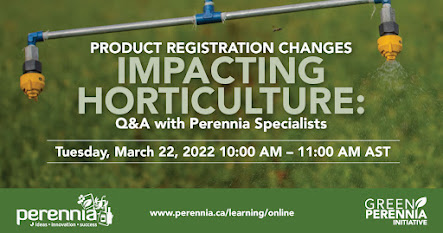
Perennia's commodity specialists are coming together to talk about product registration changes that will be coming into effect for 2022. This is a great opportunity to catch up on all things pesticides, and ask your specialist any questions you may have when it comes to label changes, use patterns and new/discontinued products. 

The focal crops during the session are apples, wild blueberries, cranberries, vegetables, berries, cannabis, and field crops. Each specialist will bring information on products that are relevant to their sector. In this conversational style webinar, we’ll answer frequently asked questions and live questions that you submit.

 For more information on the webinar, and session registration, click here

Controlled Environment Agriculture Webinar Series

Friday, January 14, 2022

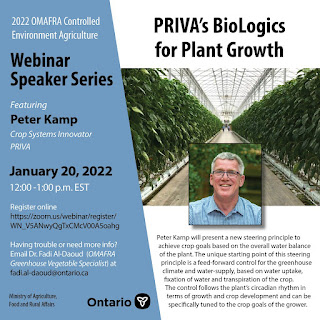
 Dr. Fadi Al-Daoud, OMAFRA's Greenhouse Vegetable Specialist, will be hosting a webinar series focused on Controlled Environment Agriculture (CEA). This will cover information relevant to all  protected crops, including berries, vegetables and floriculture. 


Join Fadi, and his guest speaker Peter Kamp, in the first installment of this webinar series on January 20, 2022 at 1 pm AST. Peter will be discussing a new crop steering principle which hinge on the basis of overall water balance within a plant. 

For those of you who are not familiar with the concept of plant steering, it operates on the basis of manipulating environmental factors to encourage vegetative or generative growth. Both vegetative and generative growth are important for establishing a healthy crop, but it is important that the timing of these two stages happens at specific time points during the cropping cycle. There are a handful of ways  we can push a crop towards increasingly vegetative growth, or increasingly generative growth, and this webinar looks to discuss a new tool to be added to our steering toolbox. For more information on crop steering, check out three of our previous posts titled 'Creating a Balance'. Each has been tagged with the tagline 'vegetative' and 'generative', so scroll through our tag list on the right side of your screen to take a look!

For anyone interested in registering for the session, click here for the link

Hope you there!

Posted by: Talia Plaskett

Product Registration Changes Impacting Horticulture: Q&A with Perennia Specialists

Wednesday, March 24, 2021

Changes are coming. Several pesticide products will be cancelled, or labels will be updated to include amendments to use patterns. The product changes come after the re-evaluation decisions by the Pest Management Regulatory Agency (PMRA) – the regulatory body that assesses the acceptability of risks according to current standards.

Join us to learn updates from our seven Perennia specialists who are here to support you in the horticulture sector. This webinar will be interactive – something that we miss by seeing you all in person! That’s why we are dedicating an entire question-and-answer period to you. In this conversational style webinar, we’ll answer frequently asked questions and live questions that you submit.

The focal crops during the session are apples, wild blueberries, cranberries, vegetables, viticulture, berries, and cannabis.

It’s like a tailgate meeting with our horticulture team! Featuring Caitlin Congdon, Francisco Diez, Sajid Rehman, Hugh Lyu, Sonny Murray, Talia Plaskett, and Michelle Cortens. Questions are moderated by Jennifer Haverstock.

If you have specific questions you'd like to see answered, you can send them to any of the crop specialists who will be sure to answer them during the webinar.

This webinar is NS Environment course number T1985 worth 1.0 point in Regulations. You must attend the entire session to receive points.

Register now!

Substrate to the Rescue!

Tuesday, March 16, 2021

The selection of suitable land has always been a key ingredient to starting a successful farm. Soil health is the root of it all, and significantly impacts your crop success from year to year. Imagine, however, that the quality of the soil is no longer a determining factor as to whether you can produce in a certain space or not. 


Substrate growing is taking crop production by storm, and for good reason! Starting each season on a blank slate, being able to choose your growing media based on water holding capacity, pH, and air porosity, and not having to worry about lingering soil-borne disease are all good reasons to consider switching to a soilless media. There is no more stress about crop rotation, counter-acting nutrient buildups, and high disease pressure.  


Protected crop specialist Talia Plaskett, and Dennis Wilson from Delphy UK, will be running two  webinars that focus on crop production in substrate. For the first session, the focus will be on examining the differences between the substrates that are available on the market. By understanding the ideal moisture content for a healthy root system, and what is required of each growing media to maintain it, you will be better equipped to start planning your next substrate-based crop.  


Even if you feel as if you have a good grasp on your substrate situation, this will be a great opportunity to ask Dennis some questions about your specific setup 


Getting into the Weeds: Dialling in Irrigation

Monday, March 1, 2021

 Perennia's winter webinar series, Getting into the Weeds: Dialling in Irrigation, continues on Monday, March 8th at 12 noon. The session with cover Fertigation - Integrating Nutrient with Irrigation Options. 


SESSION DESCRIPTION:

This session will cover the effect of using different irrigation systems and how that affects application rates and volumes. There will be discussion around timing for injection of the materials in pivot versus drip systems. We will also discuss the local difficulties with fertigation decisions, such as unpredictable weather, versus areas where fertigation is common and can be consistently planned for, such as California. We will cover the difference between soil solution and soil colloid and the concept of fertigation as a move toward outdoor hydroponics. We will discuss example materials that can be used to fertigate and how commodity macro and micronutrients can be injected into various systems. The importance of incorporating soil and tissue analysis when making fertilization recommendations will be highlighted, including some artificial intelligence methods developed to help with those interpretations.

SPEAKER INFORMATION:

Dr. Sebastian Margarit is the VP of Informatics and Agronomy at NutriAg and is the progenitor of NutriAnalytics. He is involved in developing the methods and goals for our field trials and is critical in program development worldwide. Sebastian has worked in the Ag industry for over a decade and has specialized in modelling soil and tissue data related to grower relevant yield and quality outcomes. He is currently developing modern artificial intelligence modelling methods to interpret the plant and soil ionome. He is a passionate apple farmer and is obsessed with exploring the role of secondary and micronutrients in improving yield and quality outcomes for farmers.

Click here to register!

If you've missed any of the previous sessions, or want to go back and re-watch anything, recordings can be found on Perennia's YouTube page.

Getting into the Weeds Workshop Series

Monday, April 27, 2020

The final installment of the "Getting into the Weeds" Workshop Series is now available on Perennia's YouTube channel: https://www.youtube.com/watch?v=5lMjHtcBZcM&t=3s

In this webinar, Gavin Graham, New Brunswick Minor Use Coordinator, and Peter Burgess, Perennia Integrated Pest Management Specialist discuss recent changes in the last few years to pesticides. In addition, Angela Gourd, Nova Scotia Department of Agriculture Plant Protection Coordinator, takes participants through the results from strawberry, onion, and carrot weed surveys.

Be sure to check out the other videos in this series, including "Winter Greens Production" with David Blanchard of Pleasant Hill Farm, and "Food Safety Success" with Shelly MacDonald and Elaine Grant of Perennia's Food Safety Team.